What to Do When a Student Keeps Getting Out of Their Seat
If you have a student who is constantly getting out of their seat, you probably know how quickly it can start taking over your attention.
You’re trying to teach a lesson, and they’re up sharpening a pencil. A few minutes later, they need a tissue. Then they’re walking over to another student’s desk. Then they’re standing beside you while you’re trying to work with someone else.
And every time, you find yourself saying some version of:
“Go back to your seat.”
“Please sit down.”
“You need to stay in your area.”
The student goes back, but a few minutes later, they’re up again.
When that keeps happening, I wouldn’t start by trying to find a stronger consequence or a better way to say “sit down.”
I would start by paying attention to when the student is getting up.
That can tell you a lot.

Look at when it happens
For a day or two, just notice the pattern.
Does the student get up mostly during independent work?
Does it happen during writing but not math?
Do they start moving around after they’ve been sitting for a long time?
Does it happen when they don’t understand the assignment?
Are they usually going toward other students?
Are they finding reasons to get up when it’s time to do something they don’t really want to do?
You don’t need to turn this into a complicated data collection system. You’re simply looking for a pattern.
Because “this student gets out of their seat all day” may feel true when you’re in the middle of managing it, but when you look more closely, you may realize it happens most often during one or two specific parts of the day.
And once you know that, you have a much better idea of what to try.
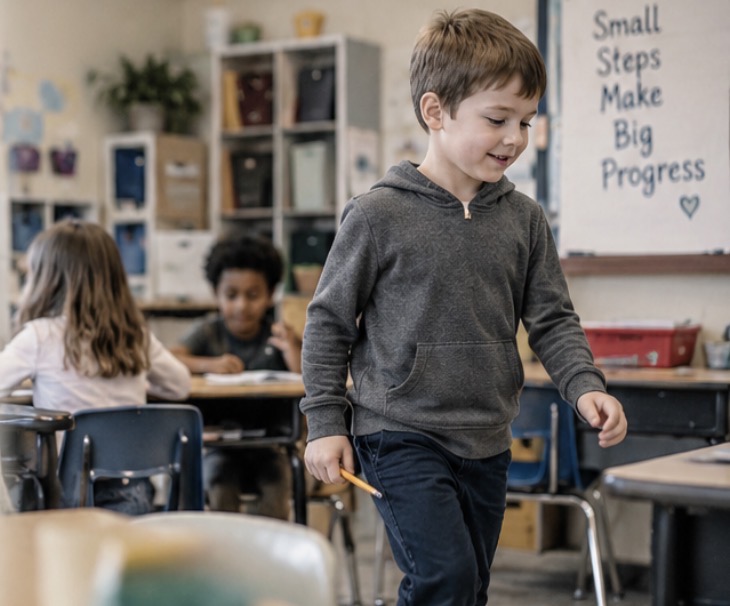
Try not to stop your lesson every time it happens
If the student is safe and isn’t bothering anyone, you may not need to stop teaching every single time they stand up.
Sometimes a quiet redirect is enough.
Move closer to the student.
Point toward their work area.
Or quietly say:
“Go ahead and head back to your spot.”
Then continue teaching.
I would try to avoid having the entire class stop and watch the same correction happen over and over again.
If you’re redirecting one student ten times during a lesson, that behavior is now taking your attention and everyone else’s attention away from what you’re trying to teach.
The correction can be calm and brief.
The student may need movement, but don’t assume that right away
Sometimes the student really does need more movement built into the day.
Young children move. Some need more opportunities for it than others.
That doesn’t mean the student should be able to walk around the classroom whenever they want. It may mean you give the movement a little more structure.
For example, maybe the student can stand at their desk while they work.
Maybe there is another work spot in the room they can use.
Maybe they complete part of an assignment and then have a quick job that gets them up and moving.
You could say:
“You can sit or stand while you do your work, but you need to stay in your work area.”
That gives the student some flexibility while still keeping a clear boundary.
But I also wouldn’t automatically decide that movement is the problem.
Sometimes getting up is a way to avoid work.
Sometimes the student doesn’t know how to begin.
Sometimes they’re looking for another student’s attention.
Sometimes they’ve gotten into a habit of roaming because no one has really helped them learn what to do instead.
That’s why noticing the pattern first matters.

If it happens during difficult work, help them get started
This is something I would especially watch for.
If the student seems to get up every time independent work begins, the issue may not actually be staying seated.
The issue may be getting started.
Maybe they don’t understand the directions.
Maybe the assignment feels too big.
Maybe they’re not sure they can do it.
In that situation, repeatedly sending them back to their seat probably isn’t going to solve much.
I might walk over and say:
“Let’s do the first one together.”
Or:
“Show me where you’re supposed to start.”
Get them into the task first.
Then see what happens.
If they settle once they know what to do, you’ve learned something important.

Talk to the student when you’re both calm
If this is happening often, I would also have a short conversation with the student outside of the moment.
Not while you’re frustrated.
Not after you’ve already redirected them six times.
Find a calmer time and say:
“I’ve noticed you’re getting up a lot during writing. What’s going on?”
With a younger student, you may not get a very detailed answer, and that’s okay.
They might tell you the work is hard.
They might say they don’t like sitting there.
They might tell you they wanted to talk to someone.
They might shrug and say, “I don’t know.”
You can still use the conversation to make a simple plan.
Maybe:
“Tomorrow, I’m going to help you get started. You’re going to work at your desk for the first part, and then you can move to the back table.”
Now the student knows what to expect, and you have something specific to follow through on.

You can support movement and still have boundaries
This part is important.
Giving a student an appropriate way to move does not mean there are no limits.
If the student is walking around distracting other students, touching materials that don’t belong to them, leaving the classroom area, or interfering with learning, I would be very clear about what is and isn’t okay.
“You can stand at your desk, but you cannot walk around while everyone else is working.”
Or:
“You can work at your desk or at the back table. Pick one.”
Then give them a chance to follow through.
You don’t need to turn it into a long conversation in the middle of instruction.
The expectation can be clear without your voice becoming harsh.

If you keep having to redirect the same behavior, look beyond the redirect
This is probably the biggest thing I want teachers to take away from this.
If you are saying “sit down” or “go back to your seat” all day long and nothing is really changing, more reminders probably aren’t going to be the answer.
Look at what is happening before the student gets up.
Look at what happens after they get up.
Look at the task.
Look at how long they’ve been sitting.
Look at who they’re trying to get near.
Look at whether they know how to begin the work.
You’re looking for information that can help you respond differently instead of having the exact same interaction twenty times a day.
Try this tomorrow
If you have a student who is constantly getting out of their seat, don’t try to fix everything tomorrow.
Just pick one part of the day when it happens often and pay attention.
What was happening right before the student got up?
Where did they go?
What happened when they got there?
What did you do?
And what happened next?
You may start seeing a pattern pretty quickly.
Once you understand the pattern, then you can decide whether the student needs a clearer expectation, some planned movement, help getting started, a different workspace, or something else.
That’s a much better place to begin than spending the whole day saying, “Please sit down.”
WANT A LITTLE MORE SUPPORT EACH WEEK?
Get The Teacher Cue delivered to your inbox every Tuesday.
One real classroom moment. One practical response. Exact words you can use. No fluff.
Click Here: SEND ME THE TEACHER CUE →

💛 Lauren
Read Next:
What to Do When Students Talk While You're Talking | K–3 Classroom Management
Students keep talking while you’re giving directions? Learn a simple K–3 classroom management reset that helps you regain attention without yelling or repeating yourself.


