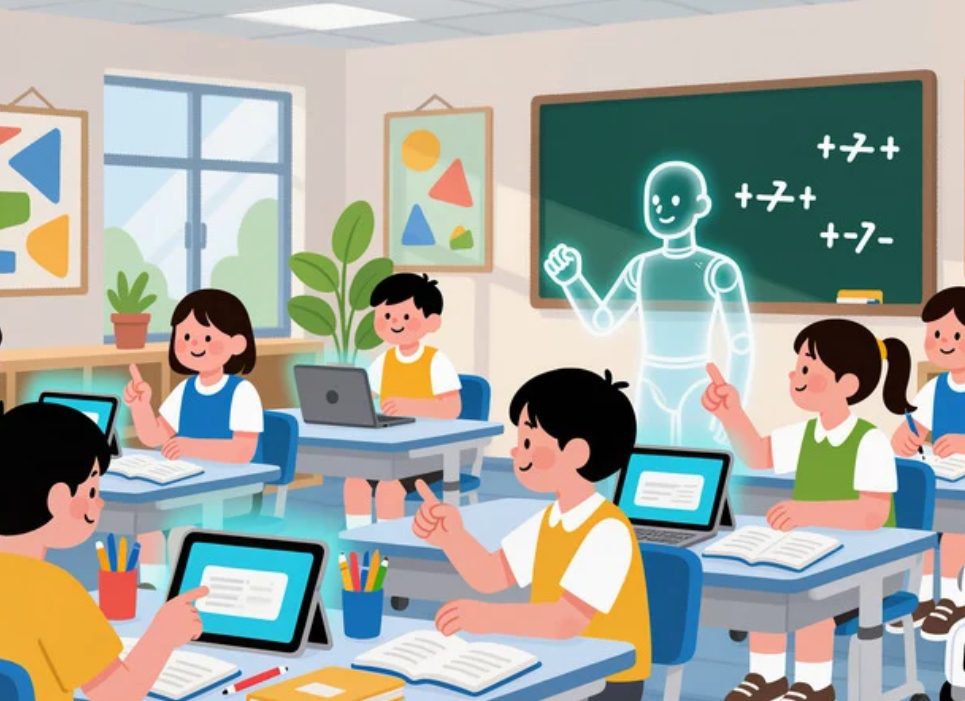
5 Smart Ways Teachers Can Use AI for Professional Reflection (And Why It Actually Works)
5 Smart Ways Teachers Can Use AI for Professional Reflection (And Why It Actually Works)
For K–3 teachers who want to grow without burning out — here's the reflection tool you never knew you needed.
You Know This Feeling…
The kids are gone. The chairs are stacked. And you're sitting at your small-group table staring at the day's lesson notes, knowing something didn't land the way you planned.
Maybe the transitions were rocky. Maybe you redirected behavior seventeen times before noon. Maybe your read-aloud was amazing — the best one you've done all year — and you can't quite figure out why.
You want to reflect. You know reflection makes you a better teacher.
But you're also exhausted. And reflection, somehow, always ends up at the bottom of the to-do list.
Here's the thing most people don't tell you about professional reflection:
It's not that teachers are too busy to reflect. It's that traditional reflection methods were never designed for how teachers actually think.
What Most Teachers Don't Know About Reflection
When we think about professional reflection, most of us picture a journal. Maybe a quiet moment with a notebook and a pen. Writing thoughtfully. Processing deeply.
Except — when's the last time a K–3 teacher had a genuinely quiet moment at school?
Here's what the research actually shows: according to educational psychologist Donald Schön, the most powerful professional learning doesn't happen after the lesson. It happens in the middle of action — what he called "reflection-in-action." And the problem is that most of us never capture those in-the-moment observations. They vanish the second the next child walks through your door.
There's also a lesser-known concept called cognitive load theory. When your working memory is full — and in a K–3 classroom, it's almost always full — the brain physically cannot encode reflective insights for long-term storage. You can't deeply process what you're also managing in real time.
This is why most teachers feel like they're constantly repeating the same mistakes or circling the same problems year after year. It's not a lack of self-awareness. It's a structural gap in when and how reflection happens.
And this is exactly where AI comes in — not as a replacement for your professional wisdom, but as a thinking partner that helps you capture, process, and actually use your reflections.

Picture Your Classroom — and Your Career — Six Months From Now
Imagine this.
You've spent the last semester checking in with an AI reflection tool for five minutes, three times a week. Not writing full paragraphs. Not journaling. Just answering a prompt, typing a few observations, having a quick back-and-forth conversation.
Now it's March. And you notice something:
You know exactly which transition in your morning routine is still causing behavior spikes — and you've already tried two adjustments that helped.
You can articulate to your instructional coach, clearly and specifically, what you need support with.
Your confidence in your own instincts is stronger. Because you've been keeping track.
That's what consistent, low-effort reflection does. It turns your daily experience into professional data. And AI makes that process faster, more organized, and honestly — more interesting than a blank journal page.
5 Smart Ways to Use AI for Professional Reflection
1. Use AI as a Daily "Brain Dump" Partner
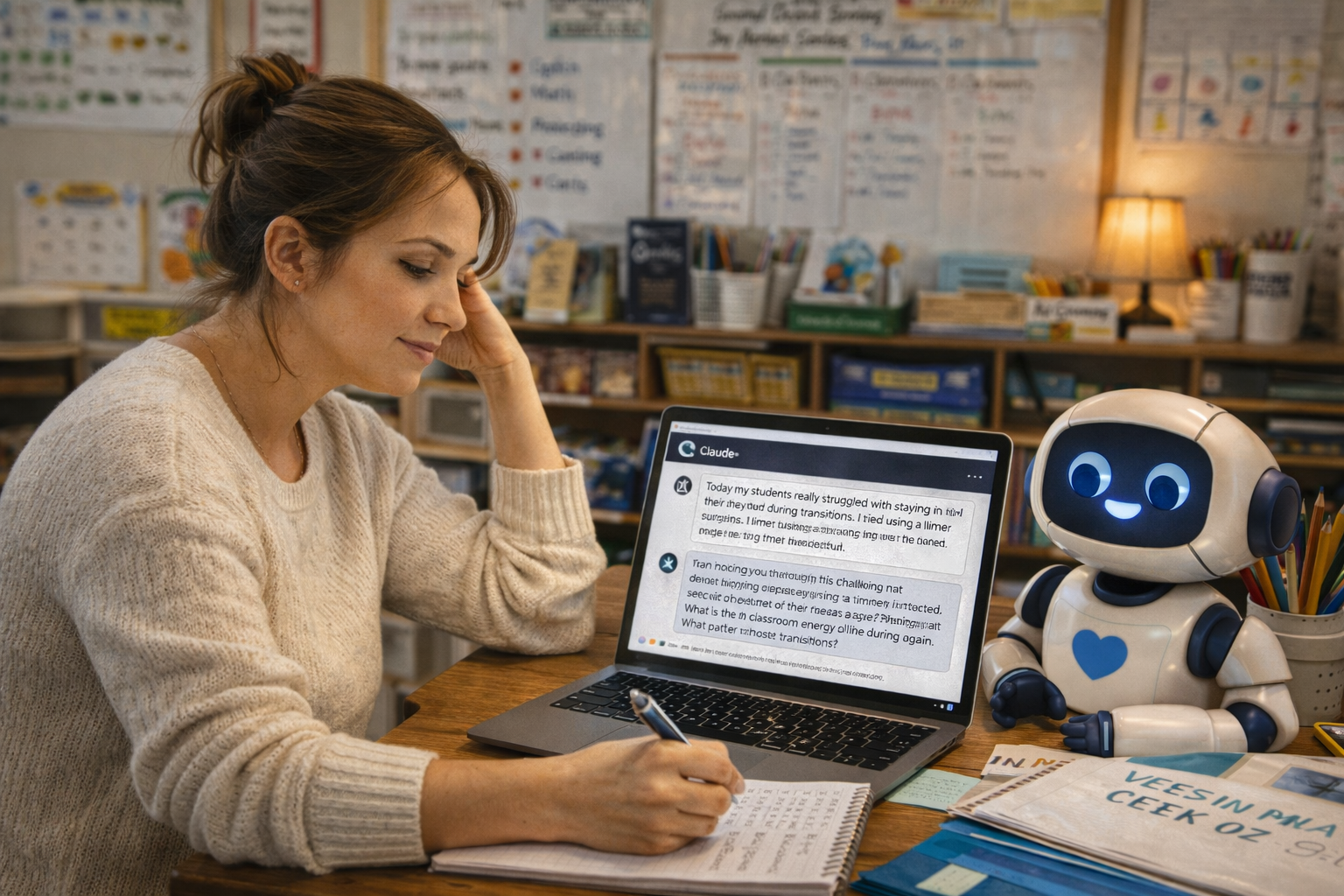
At the end of the day — even if you only have four minutes — open a conversation with an AI tool like Claude or ChatGPT and type one or two sentences about your day.
Try this prompt:
"Today my students really struggled with ___. I tried ___, and here's what I noticed: ___. What patterns might this reflect?"
You don't need to write a lot. You just need to externalize the thought before it disappears into the chaos of tomorrow morning.
The AI won't just store the observation — it will ask clarifying questions, offer possible frameworks, and help you think more deeply than you would alone.
Time required: 3–5 minutes
2. Ask AI to Help You Identify Blind Spots
One of the most fascinating — and slightly uncomfortable — uses of AI for reflection is pattern recognition.
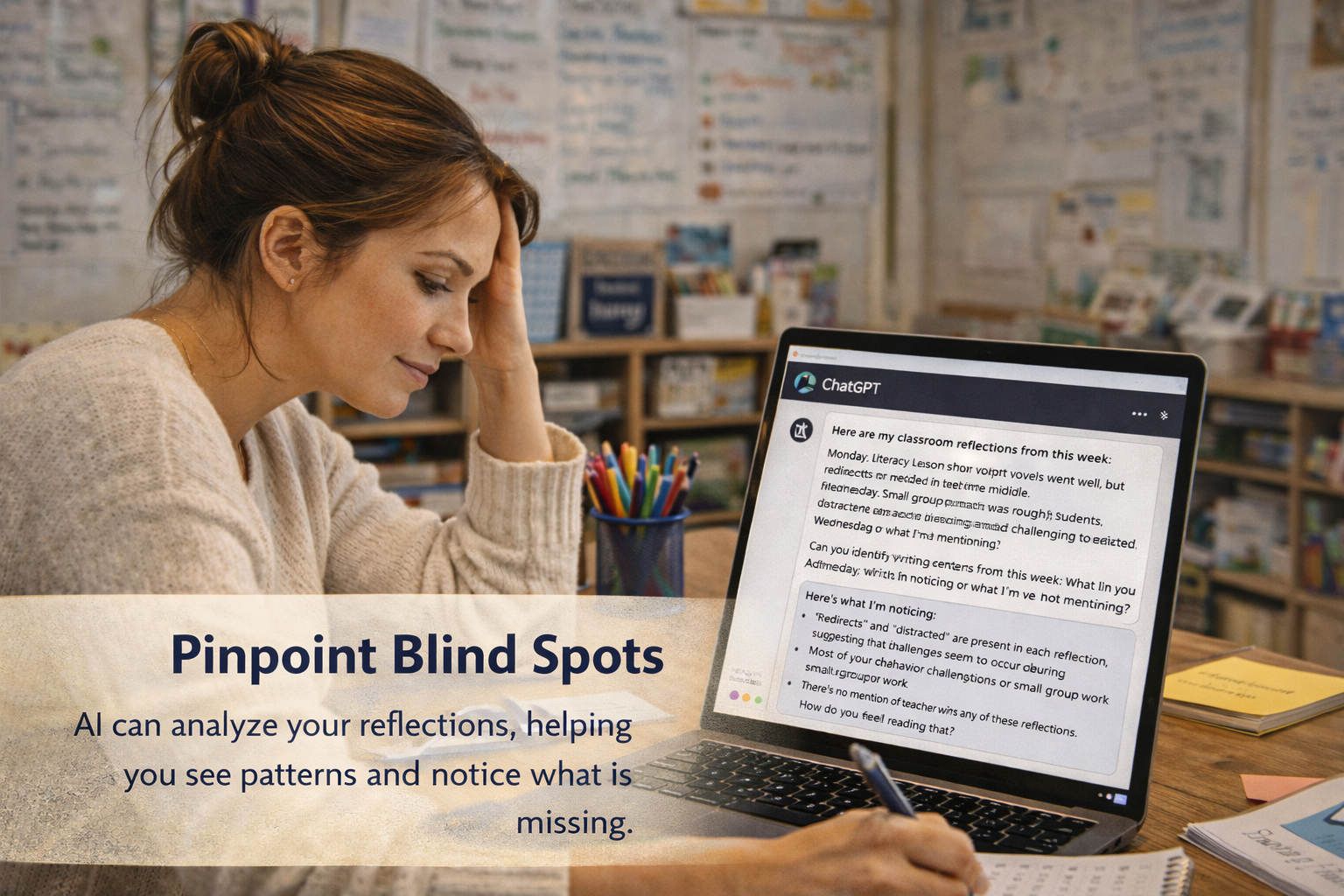
If you paste in a week's worth of daily notes, an AI tool can identify language patterns you might not notice yourself. Are you consistently describing the same three students? Are your "wins" always in literacy but rarely in transitions? Are you using the word "frustrated" more often on Wednesdays?
Try this prompt:
"Here are my classroom reflections from this week: [paste notes]. Can you identify any patterns in what I'm noticing or what I'm not mentioning?"
This is the kind of meta-reflection that most teachers never access — not because they aren't thoughtful, but because we can't easily see the patterns inside our own thinking without an outside lens.
Fact: Studies on reflective practice in teaching show that unguided self-reflection often reinforces existing beliefs rather than challenging them. An outside prompt — even from an AI — increases the likelihood of genuine insight.
3. Simulate Coaching Conversations Before They Happen
Does this sound familiar? You have an instructional coaching meeting next week. You know you want to bring up your small group rotations, but every time you try to explain the problem, the words come out muddled.
Use AI to rehearse.
Try this prompt:
"I have a coaching meeting on Thursday. I want to discuss my small group reading rotations. Can you ask me coaching-style questions so I can practice articulating what's working and what isn't?"
The AI becomes a low-stakes coaching simulator. You get to practice your thinking, sharpen your language, and walk into your real meeting with clarity.
Teachers who arrive at coaching conversations with structured reflections get significantly more targeted support — because the coach spends less time excavating the problem and more time helping you solve it.
4. Build a Personal "Teaching Portfolio" Without the Work
Here's something most teachers don't know: one of the strongest indicators of long-term teacher effectiveness is what researchers call "reflective coherence" — the ability to connect your current practice to your goals, your values, and your student outcomes over time.
Building that kind of professional narrative used to require major time investment. Now, AI can help you do it in micro-bursts.
Try this prompt:
"Based on the reflections I've shared with you over the past month, can you help me write a 3–4 sentence professional summary of my growth areas and what I'm working toward?"
Over time, these summaries become a genuine professional portfolio — one that's actually useful for evaluations, resume updates, or even just remembering why you became a teacher in the first place.
5. Process Difficult Days Without Spinning
We have to talk about the hard days.
The ones where a parent email blindsided you. Where a student's behavior escalated beyond what you were prepared for. Where you lost your patience and then spent the rest of the afternoon quietly beating yourself up.
These are the days that most need reflection — and most resist it, because the emotions are still too close.
AI can help you process without ruminating.
Try this prompt:
"I had a really hard day today. [Brief description.] I want to reflect on it productively rather than just spiral. Can you help me think through what happened, what I could do differently, and also what I actually did well?"
The key phrase is "what I actually did well." AI tools, when prompted correctly, will help you hold both the difficulty and the competence at the same time — something our exhausted brains struggle to do on their own.

Why This Works: The Brain Behind the Strategy
What makes AI-supported reflection so effective isn't the technology. It's what the technology does to your thinking process.
When you type your thoughts — even briefly — you activate a cognitive process called elaborative interrogation. You're not just remembering what happened; you're organizing it, which strengthens memory encoding and deepens understanding.
When an AI responds with a question or a pattern observation, it triggers what neuroscientists call retrieval practice — the process of pulling information out of memory actually strengthens the neural pathway, making you more likely to apply the insight in the future.
And perhaps most importantly: writing to an AI removes the self-censorship that comes with journaling. There's no audience. There's no judgment. Teachers consistently report being more honest in AI reflection prompts than they are in formal professional development surveys — because the stakes feel lower, so the thinking goes deeper.

You're Already a Reflective Teacher
Can we be honest for a second?
The fact that you're reading this? That's reflection.
The fact that you replay your lessons in the car on the way home, wondering if you could have done something differently? That's reflection.
The fact that you lie awake thinking about that one student who still isn't connecting? That's reflection.
You are already doing the work. You have been doing it all along.
What AI offers isn't a correction. It's an amplifier. It takes the professional wisdom you're already generating every single day and helps you organize it, revisit it, and actually use it.
Teaching young children is one of the most cognitively and emotionally demanding jobs on the planet. You're not just delivering content — you're holding a room full of developing humans, managing their regulation while also managing your own, making hundreds of micro-decisions every hour.
You deserve tools that actually work the way you work.

One More Tool for Your Toolkit
If you're looking for a structured way to start having these kinds of reflective conversations — especially around classroom behavior — my Student Behavior Scenario Cards are a great starting point.
Each card walks you through a real classroom scenario, gives you reflection prompts, and opens the door to exactly the kind of thinking we talked about in this post. They're designed to work in 5-minute windows, which means they're perfect for the kind of daily, low-effort reflection practice that actually sticks.
You can also find more strategies like these inside the Lesson Plan Toolbox — a growing resource library built specifically for K–3 teachers who want practical, research-backed support without the overwhelm.
Your One Action for This Week
This week, try just one AI reflection prompt. Pick one of the five strategies above — whichever one feels most relevant to where you are right now — and give it five minutes.
Not because it will transform your practice overnight.
But because the teachers who grow most consistently are the ones who build small, sustainable habits of noticing.
And you? You're already a noticer.
— Now you just have a better place to put what you see.
DID YOU KNOW…
Did you know I organize a FREE Facebook Group for Mastering Classroom Management? We are gearing up for our summer sessions, so if you’re looking for a simple way to improve your classroom management join the already 200+ teachers that have signed up: Mastering Classroom Management Facebook Group
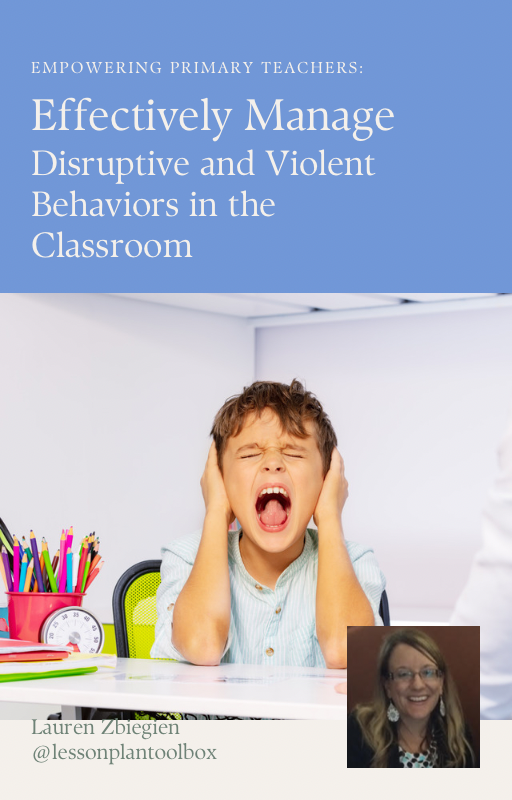
Your ebook GIFT: Empowering Primary Teachers: Effectively Manage Disruptive and Violent Behaviors in the Classroom
FINALLY…
If you enjoyed the tips in this post, you might also enjoy this series of Classroom Management by Design for Primary Teachers:
The Hidden Reason Some Students Can't Focus Before Lunch
Teaching Accountability to Young Students: A Practical Guide for K–3 Teachers
Unlock the Key to Supporting Neurodivergent Learners - Without Overwhelm
Finished Early? Now What? 10 Brilliant Ways to Keep Students Engaged Without the Chaos
A Guide to Creating an Intrinsically Motivated Classroom
Expanding AI's Role in the Primary Classroom
Unlock the Power of AI in the Primary Classroom
Supporting a Student Being Bullied
Don’t forget to follow us over on Instagram!
Teach~Relax~Repeat
Lauren
About Lesson Plan Toolbox
Lesson Plan Toolbox helps K–3 teachers build calm, structured, emotionally regulated classrooms through brain-based systems, movement integration, and ready-to-use behavior tools — so they can teach with confidence instead of stress. Founded by an educator with 20+ years of classroom and assistant principal experience.


