Get Students Focused Fast with Simple Movement Management
Welcome to our yearlong series on Classroom Management by Design for Primary Teachers. Each week we will give you a new piece to the classroom management puzzle to have in place when you need it this school year. Think of it as a Lego kit just waiting to be built.
Classroom Management by Design for Primary Teachers: Get Students Focused Fast with Simple Movement Management
Classroom management with movement built in is one of the most powerful ways to improve behavior, boost attention, and create a calmer learning environment in primary classrooms. When students are invited to move with purpose, the mind–body connection helps them regulate emotions, reset their focus, and engage their imaginations in the learning process. This movement-based classroom management approach is not about adding more “stuff” to a busy day; it is about weaving small, intentional movement routines into what teachers are already doing.twinkl+3

Why Movement Matters for Classroom Management
Research on classroom movement shows that physical activity supports attention, working memory, and on-task behavior. Short, structured movement breaks reduce restlessness and help students release excess energy before it turns into disruptive behavior.educator-academy+2
For primary teachers, this means movement is not a distraction from learning; it can become a key classroom management strategy. When students know that their bodies will have chances to move and reset, they are more likely to stay engaged during instruction. Movement also supports the mind–body connection by helping students notice how their bodies feel when they are calm, focused, or dysregulated.twinkl+1

The Mind–Body Connection in the Classroom
The mind–body connection simply means that thoughts, feelings, and physical sensations are linked. In a primary classroom, this might look like students noticing that their hearts beat faster when they are excited or frustrated and using simple movement and breathing to calm down. Mind–body classroom management strategies help children tune into these signals and choose appropriate tools, rather than acting out.
Mindfulness practices such as deep breathing, grounding, and body scans can be combined with gentle movement to create powerful regulation routines. When teachers embed these mind–body routines into daily procedures—morning meetings, transitions, and brain breaks—students learn consistent ways to reset without needing constant teacher direction.educator-academy+1

Movement-Based Classroom Routines
Movement-based classroom routines are everyday procedures that include simple motions so students are not stuck sitting all day. These routines might be part of lining up, turning in work, transitioning between subjects, or regaining attention. The goal is to use movement to prevent misbehavior, not just react to it.
For example, instead of calling students one by one to line up, a teacher might invite them by movement prompts: “If you are wearing blue, tiptoe to the line like a sneaky cat.” This playful movement gives students a clear expectation while channeling their energy. Another movement-based classroom management routine is using a short stretch sequence when the class starts to lose focus: reach up high, fold forward, roll shoulders, and take a deep breath.childsplayinaction+1

Brain–Body Breaks That Reset Behavior
Brain–body breaks are short activities that combine physical movement with mental focus to refresh students’ attention. These breaks typically last one to three minutes and can be used before independent work, after a challenging task, or when teachers notice early signs of dysregulation.twinkl+1
Effective brain–body breaks for behavior include:
Gentle stretching with breathing, such as reaching for the sky and exhaling slowly while lowering the arms.educator-academy+1
Animal walks (bear walks, crab walks, slow turtle steps) that give heavy work to muscles and joints, which can be calming for many children.studiesweekly+1
Cross-body movements such as touching opposite elbow to knee, which can support coordination and focus.lsa.umich+1
The key is that brain–body breaks are structured and predictable. Students know what to expect, and teachers can use consistent language like “We are going to take a brain–body break to help our bodies get ready to learn.”

Attention Signals with Built-In Movement
Attention signals are a core part of classroom management, and adding movement makes them more effective. Instead of relying only on clapping patterns or verbal cues, teachers can create movement-based attention signals that quickly engage students’ bodies and minds.
One option is a simple movement pattern students copy: the teacher places hands on head, shoulders, then heart, and students follow silently. Another idea is a set of three “focus poses” that students move through when they hear a chime or see a visual cue. These movement-based attention signals give students a physical way to shift from noise to quiet and from off-task to ready. Because the routine is the same every time, it becomes automatic, which strengthens classroom management.twinkl+1

Creative Movement for Classroom Management
Creative movement activities invite students to use their imaginations while practicing self-control, listening, and cooperation. These activities are perfect for transitions, community-building, and literacy or social studies lessons. When students are engaged in imaginative movement, there is less room for off-task behavior and more opportunity to develop empathy and problem-solving skills.childsplayinaction+1
One powerful strategy is role-play and frozen tableaux. Students act out “what following the rule looks like” and then freeze, then act out “what it does not look like” and freeze again. This makes expectations visible and playful instead of punitive. Another creative movement idea is character walks: students move around the room like a character from a story—quietly and safely—before gathering for a discussion. This supports comprehension, imagination, and classroom management at the same time.responsiveclassroom+1

Reteaching Expectations with Movement
After breaks or during midyear resets, many teachers need to reteach expectations and routines. Combining this work with movement helps students internalize what is expected more quickly and positively. Instead of lecturing about rules, teachers can ask students to act out the right and wrong ways to walk in the hallway, use supplies, or sit on the carpet.chalkandapples+1
Movement-based reteaching might include:
Students modeling routines as “experts” while peers copy the motions.
Quick “practice rounds” of lining up or cleaning up, framed as a game to see if the class can complete the routine calmly in a set time.
Simple movement cues attached to expectations, such as a hand on heart for “respect” or two hands on shoulders for “personal space.”
These approaches keep reteaching active and engaging so students are less likely to tune out.

Practical Tips for Getting Started
Movement-based classroom management does not require a full classroom redesign. It starts with a few intentional choices and small routines. Teachers can begin by choosing one part of the day to redesign with movement, such as transitions or morning meeting.
Helpful first steps include:
Selecting two or three brain–body breaks and teaching them explicitly, practicing when the class is calm so students know what to do.educator-academy+1
Replacing one existing attention signal with a movement-based signal and using it consistently for at least two weeks.
Adding a short reflection prompt after movement, such as “Notice how your body feels now” or “Are you more ready to learn?” to strengthen the mind–body connection.
Over time, these small movement-based classroom management strategies build a culture where students understand their bodies, recognize when they need a reset, and use movement as a tool instead of acting out. This approach helps teachers create a classroom where behavior supports learning, energy feels purposeful, and imagination has room to grow.
https://www.twinkl.com/blog/brain-breaks-and-mindfulness-in-primary-classrooms
https://educator-academy.org/brain-body-breaks-in-the-classroom/
https://artsintegration.com/2017/09/01/creative-movement-classroom-management/
https://www.responsiveclassroom.org/seven-tips-for-the-transition-back-to-school-from-winter-break/
https://chalkandapples.com/how-to-set-classroom-expectations-for-january/
Manage Student Behavior in 5 Minutes a Day!
Do you see student behavior going through the roof right about now?
Have you tried EVERYTHING and NOTHING seems to work?
Trust me, I've been there!
This is EXACTLY why I created The Student Behavior Scenario of the Day Cards for primary teachers. You will improve student behavior AND your classroom management in just 5 minutes a day!
As teachers, we can't assume that students know how to behave or what is expected of them and so often that is where things go wrong for us. (We all know what happens when we ''assume", but yet we still do it anyway.)
These cards changed EVERYTHING for me in the primary classroom because students LOVE talking about behavior AND they want to meet your expectations.
Best of all, each card has scenario of the day, reflection questions, and possible consequences that teachers can use in each situation.
GRAB YOUR FREE SAMPLE HERE: Student Behavior Scenario of the Day Cards
DID YOU KNOW…
Did you know I organize a FREE Facebook Group for Mastering Classroom Management? We are gearing up for our school year quarter sessions, so if you’re looking for a simple way to improve your classroom management join the already 200+ teachers that have signed up: Mastering Classroom Management Facebook Group
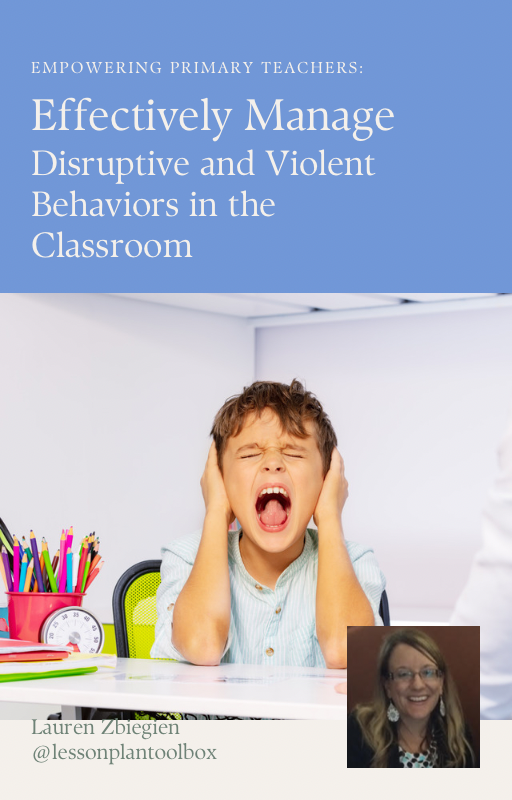
Your ebook GIFT: Empowering Primary Teachers: Effectively Manage Disruptive and Violent Behaviors in the Classroom
FINALLY…
If you enjoyed the tips in this post, you might also enjoy this series of videos Classroom Management by Design for Primary Teachers:
Unlock the Key to Supporting Neurodivergent Learners - Without Overwhelm
Finished Early? Now What? 10 Brilliant Ways to Keep Students Engaged Without the Chaos
A Guide to Creating an Intrinsically Motivated Classroom
Expanding AI's Role in the Primary Classroom
Unlock the Power of AI in the Primary Classroom
Supporting a Student Being Bullied
What to do With a Bully in the Primary Classroom
Don’t forget to follow us over on Instagram!
Teach~Relax~Repeat
Lauren