Mindful Moments That Change Everything: Daily Routines to Calm, Focus, and Inspire Your K-3 Classroom
Welcome to our yearlong series on Classroom Management by Design for Primary Teachers. Each week we will give you a new piece to the classroom management puzzle to have in place when you need it this school year. Think of it as a Lego kit just waiting to be built.
Classroom Management by Design for Primary Teachers: Mindful Moments That Change Everything: Daily Routines to Calm, Focus, and Inspire Your K-3 Classroom
Imagine starting your day not with chaos, but with calm — a class of eager young learners settled in, focused, and ready to discover. 🌞
In a world filled with distractions, mindfulness gives primary teachers a transformative way to help students build attention, empathy, and stillness. But what does mindfulness really look like in a K–3 classroom? And how can you make it work for your students — and yourself?

🌿 Why Mindfulness Matters for Today’s Teachers
Modern classrooms are vibrant, energetic, and… let’s be honest, sometimes overwhelming. Between student needs, curriculum demands, and unexpected behaviors, it’s easy to crave just one moment of peace.
Mindfulness isn’t just a buzzword. It’s a research-backed practice proven to improve emotional regulation, focus, and resilience — not only for students, but for teachers too.
Educators who practice mindfulness report feeling less stressed, more patient, and more present. Students benefit from better self-regulation, reduced anxiety, and a deeper sense of joy — even on the busiest days.
🧘♀️ Are You Craving Calm in Your Classroom?
Ever wish your students could focus for more than 10 minutes?
Do transitions feel a little less peaceful than you’d like?
You’re not alone. Across the country, teachers are searching for practical ways to nurture calm and focus. The good news: you don’t need to add one more thing to your plate — mindfulness works best when it’s woven naturally into what you’re already doing.

1️⃣ What Is Mindfulness? Simple, Classroom-Friendly Definitions
Mindfulness is paying attention to the present moment on purpose — with kindness and curiosity.
For children, that means noticing what they see, hear, and feel — without judgment. For teachers, it might look like taking a slow breath before calling the next group to the carpet or a one-minute pause after recess to reset the class energy.
The magic of mindfulness is consistency, not complexity. It’s the small moments — repeated daily — that make the biggest difference.
🧠 The Science Behind Mindfulness and the Young Brain
Research shows even brief mindfulness practices can strengthen the brain’s “attention muscles.” MRI studies reveal improved connections between the parts of the brain that manage focus and decision-making.
For teachers, mindfulness lowers the stress hormone cortisol — helping you model the calm you wish to see in your students.

✨ Real-Life Classroom Moments
Ms. Garcia’s First Graders: They start each morning with three “Mindful Breaths.” The calm energy sets the tone for the entire day — and helps Ms. Garcia feel centered too.
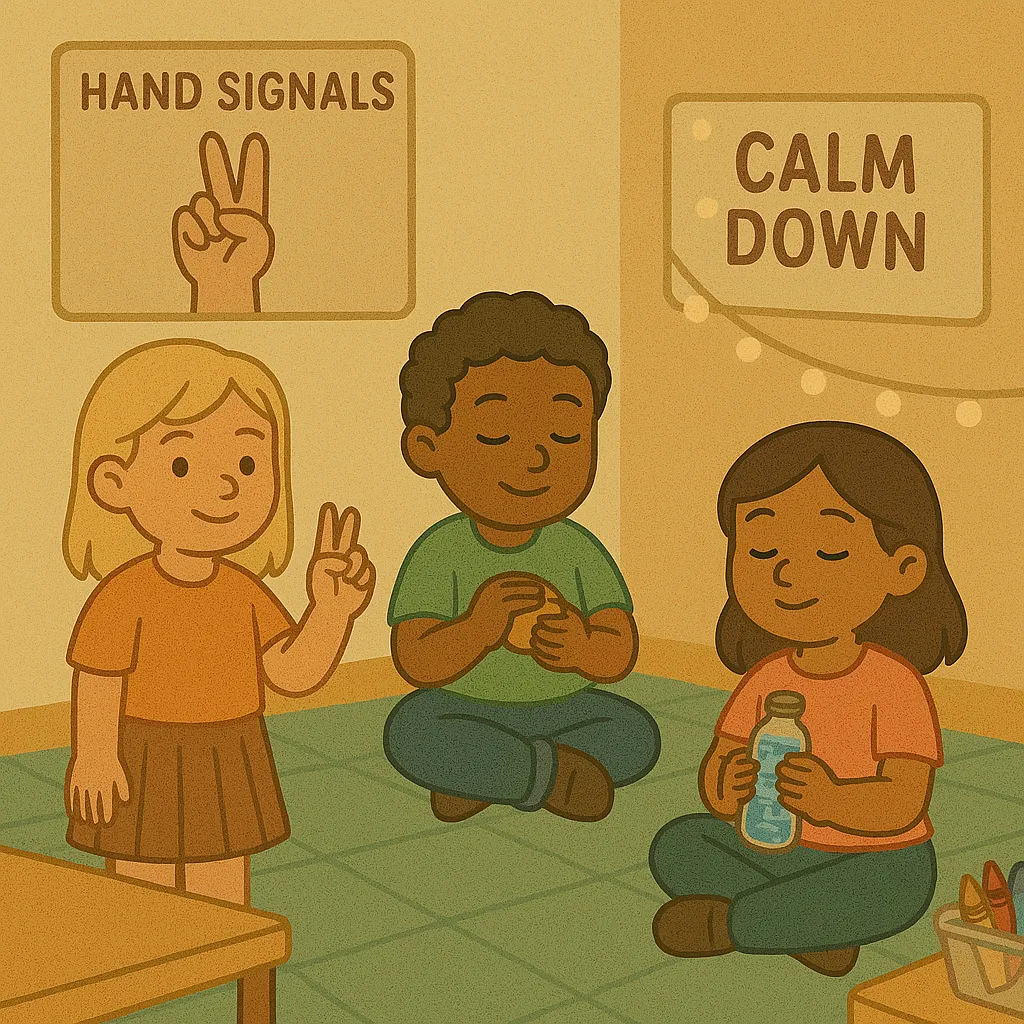
Mr. Lee’s K-2 Class: He uses a “Peace Corner” filled with ocean tones, soft pillows, and butterfly visuals where students can breathe and reset.
Ms. Patel’s Transition Trick: Before switching subjects, students place “Focus Hands” on their desks, close their eyes, and listen for a soft chime. Ten seconds later — peaceful transition achieved.
🌅 Spotlight: Morning Mindset — A Mindful Start for Students
One of the most powerful mindfulness routines is Morning Mindset — a calm, three-step reflection that takes just a few minutes at arrival.
Students:
Share how they’re feeling and why.
Set a personal goal for the day.
Write or choose a positive affirmation.
This gentle ritual builds self-awareness, focus, and confidence before the first bell even rings. Teachers report calmer transitions, greater empathy, and an overall shift in classroom climate.
How to Try It:
Have students complete a short form or journal entry during morning arrival.
Use soft, beach-calm colors and sunshine visuals to set a peaceful tone.
Encourage students to share their affirmations aloud — it builds community and accountability.
Reflect as a class: “Who’s working on staying calm today?” “Who’s ready to be kind?”
When kids begin the day with reflection and intention, they’re more ready to learn and lead with empathy.

💬 Support for Students Who Struggle with Self-Reflection
Even young learners can engage in mindfulness when it’s modeled gently and consistently. Try these strategies:
Model Reflection Aloud: Share your own affirmation and feeling:
“I’m feeling excited because we’re trying something new. My goal is to listen carefully today.”Offer Visual Supports: Use emotion charts, color check-ins, or “I Feel” cards for students who need nonverbal options.
Keep It Short and Safe: Ask one question at a time and celebrate effort.
Build Routine: Schedule reflection at the same time daily to build comfort.
Allow Choice: Let students draw or use symbols if writing feels hard.
Encourage Privacy: Some reflections are better kept personal — that’s okay.
Celebrate Growth: Calm praise like, “I noticed you picked your affirmation today!” goes a long way.
💡 Easy Mindfulness Activities for Busy Teachers
Here are three tried-and-true ideas that fit easily into a primary classroom:
Mindful Mornings – Start with a “weather check”:
“Are you sunny, cloudy, or stormy today?”Listening Walks – Take 60 seconds to hear the hum of the lights, a friend’s whisper, or your own breath.
Sensory Stillness – After recess, pass around smooth stones or use a chime to help the class settle before learning.

❤️ Mindfulness Meets SEL (Social-Emotional Learning)
Mindfulness and SEL go hand-in-hand. When students name their feelings and notice their bodies, they learn self-awareness and empathy — two of the core SEL competencies.
Use language like, “Let’s take a moment to notice how our bodies feel right now.”
This helps students connect emotions to choices and actions.
🔁 Building Consistency: Rituals That Stick
Choose one mindful moment each day — after lunch, before circle time, or during transitions. Stick with it for eight weeks. You’ll start to see:
smoother transitions
student-led reminders (“Can we do our Focus Hands?”)
calmer energy overall
The goal isn’t perfection — it’s presence.

🎨 Classroom Calm: Why Visuals Matter
The environment teaches too.
Soft tones — think ocean blues, sunshine yellows, and butterfly imagery — can reinforce the feeling of peace.
Create a calm-corner visual board or mindful poster set to help anchor your routines.
🌼 Want Even More Calm Classroom Tools?
If you loved today’s mindfulness ideas, you’ll find even more support inside our Lesson Plan Toolbox Membership. Members get access to:
Morning Mindset Tracker — a printable and digital reflection routine that helps students start the day focused and confident.
Teacher & Student Affirmation Cards — classroom visuals that promote calm, positivity, and belonging.
Student Behavior Scenario Cards — five-minute stories and discussion prompts that build empathy and self-regulation.
These ready-to-use resources are part of the Foundational Framework Toolbox — created to help you build consistent routines, nurture social-emotional growth, and restore peace to your classroom (and yourself).
✨ You were made to teach — we’re here to make it a little easier.
🌻 Try It Today, Share Tomorrow
Ready to bring mindfulness into your classroom?
Start with one technique this week — maybe Mindful Mornings or Morning Mindset.
And don’t miss next week’s post:
“Building Stillness—Why Quiet Moments Matter.”
Because sometimes, the most powerful teaching happens in the quiet.
Manage Student Behavior in 5 Minutes a Day!
Do you see student behavior going through the roof right about now?
Have you tried EVERYTHING and NOTHING seems to work?
Trust me, I've been there!
This is EXACTLY why I created The Student Behavior Scenario of the Day Cards for primary teachers. You will improve student behavior AND your classroom management in just 5 minutes a day!
As teachers, we can't assume that students know how to behave or what is expected of them and so often that is where things go wrong for us. (We all know what happens when we ''assume", but yet we still do it anyway.)
These cards changed EVERYTHING for me in the primary classroom because students LOVE talking about behavior AND they want to meet your expectations.
Best of all, each card has scenario of the day, reflection questions, and possible consequences that teachers can use in each situation.
GRAB YOUR FREE SAMPLE HERE: Student Behavior Scenario of the Day Cards
DID YOU KNOW…
Did you know I organize a FREE Facebook Group for Mastering Classroom Management? We are gearing up for our school year quarter sessions, so if you’re looking for a simple way to improve your classroom management join the already 200+ teachers that have signed up: Mastering Classroom Management Facebook Group
Your ebook GIFT: Empowering Primary Teachers: Effectively Manage Disruptive and Violent Behaviors in the Classroom
FINALLY…
If you enjoyed the tips in this post, you might also enjoy this series of videos Classroom Management by Design for Primary Teachers:
Unlock the Key to Supporting Neurodivergent Learners - Without Overwhelm
Finished Early? Now What? 10 Brilliant Ways to Keep Students Engaged Without the Chaos
A Guide to Creating an Intrinsically Motivated Classroom
Expanding AI's Role in the Primary Classroom
Unlock the Power of AI in the Primary Classroom
Supporting a Student Being Bullied
What to do With a Bully in the Primary Classroom
Don’t forget to follow us over on Instagram!
Teach~Relax~Repeat
Lauren