Quiet Moments That Boost Focus in Your K-3 Classroom
Welcome to our yearlong series on Classroom Management by Design for Primary Teachers. Each week we will give you a new piece to the classroom management puzzle to have in place when you need it this school year. Think of it as a Lego kit just waiting to be built.
Classroom Management by Design for Primary Teachers: Quiet Moments That Boost Focus In Your K–3 Classroom
Because calm isn’t a luxury in primary classrooms — it’s the backbone of learning.
If your classroom ever feels like it’s powered by buzzing bees, you are not alone. Young learners come to school full of feelings, movement, noise, confusion, and constant input from screens, routines, and social dynamics. But research continues to point to one beautifully simple classroom tool that stabilizes all of this: intentional quiet moments woven into the school day.
Stillness is not perfection, silence, or unrealistic teacher expectations. It isn’t a room where no one moves and no pencil makes a sound. It is the mindful practice of helping students pause, notice, breathe, and reset—so their brains and bodies are organized enough to learn. In K–3 classrooms, these tiny quiet pauses become powerful SEL anchors and behavior stabilizers, working underneath the noise like a steady heartbeat.
Why Quiet Matters for Young Brains 🧠💛
When noise is constant and speed is high, children’s brains stay in alert mode. Busy auditory environments are linked to increased cortisol levels and lowered processing ability. Quieter environments, by contrast, support attention, comprehension, and emotional regulation.
Intentional quiet—just a few minutes at a time—provides:
A reset for overstimulated nervous systems
A chance for deeper cognitive processing
The brain space required for memory and learning to stick
In K–3, stillness isn’t a cute add-on. It is a neuroscience-backed regulation tool that strengthens the “focus muscle” students will rely on for the rest of their academic lives.

Stillness Builds Self-Control (One Minute at a Time)
Stillness, contrary to how it can sometimes be framed, is not innate. It is taught and practiced. Guided quiet moments—breathing, noticing sounds, silently studying an image—help students learn to direct attention on purpose.
Research shows that early mindfulness practice improves:
Focus
Listening stamina
Return-to-task ability
Patience while waiting a turn
These skills do not magically activate in January or after a long weekend. They strengthen slowly and consistently, through reps. You don’t build a runner in a single jog, and you don’t build student regulation in a single “quiet moment.” You build it in layers.

Quiet Moments Support Emotional Regulation 🌿
Quiet moments aren’t “extra” — they are emotional safety rails. When students experience frustration, worry, sensory overload, or big feelings, stillness gives them the missing step between emotion and reaction: processing.
Mindful breathing, calm corners, and reflection cues are linked to decreases in dysregulated behaviors and improved self-regulation, especially when explicitly taught. Students report that quiet tools help them when they feel angry, nervous, or sad because they know what to do with those feelings instead of acting them out.
In K–3, quiet time lets children:
Name the feeling
Notice its body signals
Use a tool (breathing, counting, stretching, visual focus) to settle
These two-minute pauses are not interruptions to instructional time—they prevent meltdowns that would have consumed instructional time later.

Stillness Creates Room for Thought ✍️🤔
Silence is not emptiness. It is cognitive space.
Quiet reflections give students time to sit with ideas, form opinions, generate questions, and craft responses. Even one minute of stillness after a read-aloud or math challenge changes the quality of what students share next.
Simple prompts help anchor quiet thinking:
“What connection can you make?”
“What surprised you?”
“What do you still wonder?”
When you treat silence as thinking time rather than waiting time, students learn to pause before responding, not race to the answer.

Practical Ways to Build Stillness in K–3 🧘♀️📚
Stillness works best when predictable, short, and explicitly taught. Start with:
Morning Stillness Check-In: quiet breathing, noticing sounds, or tracing patterns to start the day regulated.
Post-Recess Reset: brief drawing, reading, or rest time with soft music or peaceful silence.
Micro Mindfulness in Lessons: 30–60 seconds of quiet belly-breaths before returning to academic tasks.
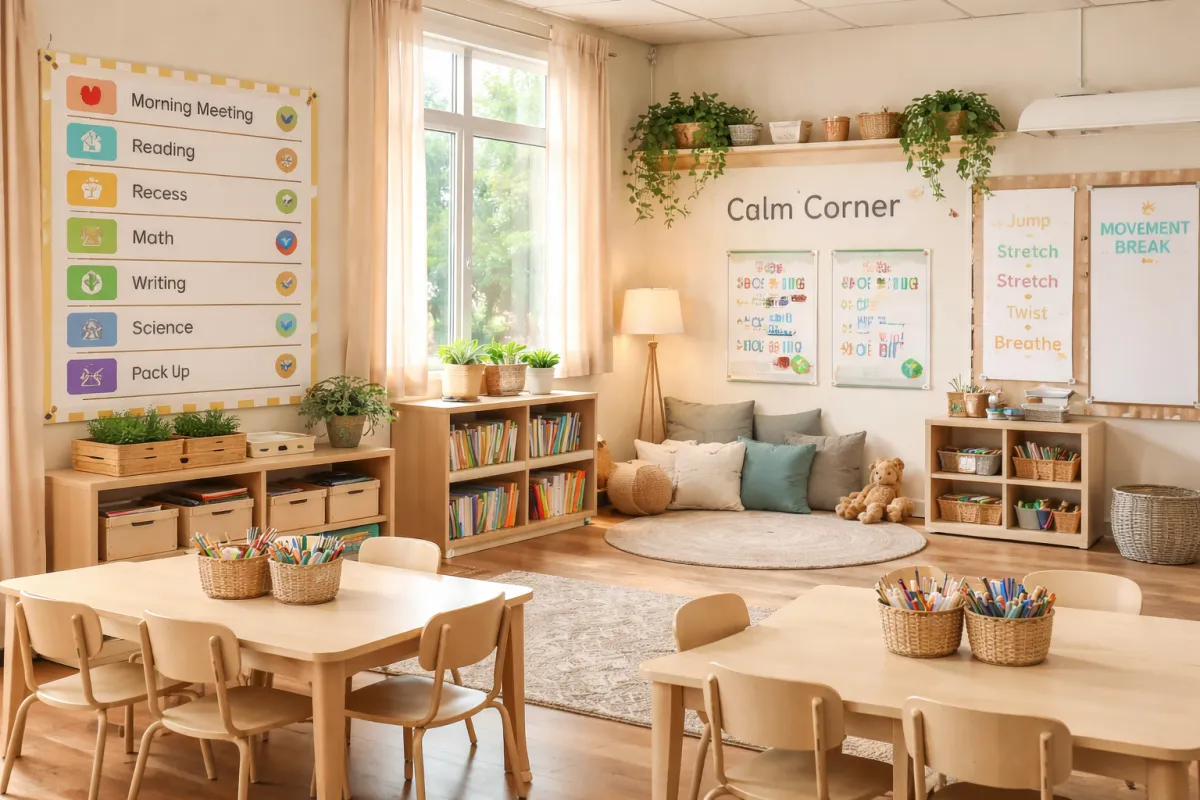
Calm-Down Spaces with Structure: clear expectations for when to use it and how—breathing visuals, glitter jars, reflection cards.
The magic isn’t in the length; it’s in the consistency.

Teaching Stillness Like a Routine (Not a Punishment)
Young children are not “bad at being quiet.” They are just new at it.
Stillness must be modeled:
What bodies do
What eyes do
What voices do
And reinforced:
“I noticed how calm your breathing was.”
“Your body stayed steady during our quiet moment.”
SEL-informed approaches emphasize that when stillness is framed as a tool—not compliance—students of all energy levels benefit, even the wiggliest among them.

Why It Matters Now More Than Ever 🌍
Today’s learners are navigating more noise, digital stimulation, emotional weight, and sensory input than any generation before them. Schools that integrate quiet time, calm-down tools, and mindfulness see gains in behavior, self-regulation, and in some cases academic performance.
Stillness in K–3 is not about a perfectly silent classroom; it is about a rhythm of activation and rest. These moments communicate to children:
Your nervous system matters.
You are allowed to slow down.
We can learn how to bring calm to our bodies and minds.
That is psychological safety in action.

Bringing It All Together ✨
A calm classroom is not built on volume control—it is built on regulation opportunities. Stillness is that opportunity. Not an add-on. Not a bonus. Not a luxury you squeeze into Friday afternoons if time allows.
But a quiet, consistent, minutes-long rhythm that teaches students how to exist in a busy world without losing themselves.
One mindful breath.
One quiet reset.
One small pause at a time.
That is how classroom peace is built—slowly, gently, consistently.
Manage Student Behavior in 5 Minutes a Day!
Do you see student behavior going through the roof right about now?
Have you tried EVERYTHING and NOTHING seems to work?
Trust me, I've been there!
This is EXACTLY why I created The Student Behavior Scenario of the Day Cards for primary teachers. You will improve student behavior AND your classroom management in just 5 minutes a day!
As teachers, we can't assume that students know how to behave or what is expected of them and so often that is where things go wrong for us. (We all know what happens when we ''assume", but yet we still do it anyway.)
These cards changed EVERYTHING for me in the primary classroom because students LOVE talking about behavior AND they want to meet your expectations.
Best of all, each card has scenario of the day, reflection questions, and possible consequences that teachers can use in each situation.
GRAB YOUR FREE SAMPLE HERE: Student Behavior Scenario of the Day Cards
DID YOU KNOW…
Did you know I organize a FREE Facebook Group for Mastering Classroom Management? We are gearing up for our school year quarter sessions, so if you’re looking for a simple way to improve your classroom management join the already 200+ teachers that have signed up: Mastering Classroom Management Facebook Group
Your ebook GIFT: Empowering Primary Teachers: Effectively Manage Disruptive and Violent Behaviors in the Classroom
FINALLY…
If you enjoyed the tips in this post, you might also enjoy this series of videos Classroom Management by Design for Primary Teachers:
Unlock the Key to Supporting Neurodivergent Learners - Without Overwhelm
Finished Early? Now What? 10 Brilliant Ways to Keep Students Engaged Without the Chaos
A Guide to Creating an Intrinsically Motivated Classroom
Expanding AI's Role in the Primary Classroom
Unlock the Power of AI in the Primary Classroom
Supporting a Student Being Bullied
What to do With a Bully in the Primary Classroom
Don’t forget to follow us over on Instagram!
Teach~Relax~Repeat
Lauren