
Teacher Burnout in K-3: How Self-Talk Affects Stress, Focus, and Classroom Management
Welcome to our yearlong series on Classroom Management by Design for Primary Teachers. Each week we will give you a new piece to the classroom management puzzle to have in place when you need it this school year. Think of it as a Lego kit just waiting to be built.
Classroom Management by Design for Primary Teachers: Teacher Burnout In K–3: How Self-Talk Affects Stress, Focus, And Classroom Management
There’s a moment many teachers don’t talk about.
It doesn’t happen during the lesson.
Or during dismissal.
Or even during the meeting where you nodded, took notes, and held yourself together.
It happens later.
In the car.
In the kitchen.
In the quiet space where the day finally stops asking something of you.
That’s when the voice shows up.
I should’ve handled that better.
Why does this feel harder than it used to?
Other teachers seem to manage this. What’s wrong with me?
If you’re a veteran K–3 teacher in 2026, this inner commentary may feel constant. You’re experienced. You care deeply. You’ve refined your classroom management over years. And yet teaching feels heavier than it once did.
That doesn’t mean you’re failing.
It means your teacher self-talk is under more pressure than ever.
Teacher Self-Talk Is Not Just Mindset. It’s a Burnout Factor.
Teacher self-talk is the internal narration running beneath every part of your day. It interprets student behavior, chaotic transitions, parent emails, and lessons that don’t land the way you hoped.
And research shows this internal dialogue plays a powerful role in teacher burnout and well-being.
Studies on teacher burnout consistently identify emotional exhaustion and self-doubt as core components, especially when teachers interpret challenges as personal failures rather than situational problems. A comprehensive review of burnout research published in Frontiers in Psychology explains how emotional exhaustion and depersonalization increase when teachers internalize stress rather than contextualize it (Frontiersin.org).
At the same time, teachers who report higher self-efficacy—the belief that they can influence student learning—experience lower burnout and greater job satisfaction. One large study of over 300 special education teachers found that higher teaching self-efficacy and self-esteem were associated with significantly lower emotional exhaustion and depersonalization (Pmc.ncbi.nlm.nih.gov).
In simple terms:
When teachers trust their capacity to adapt, their inner voice shifts from self-blame to problem-solving.

Why Self-Compassion Changes the Inner Voice
Self-compassion is often misunderstood as lowering standards. In reality, research shows the opposite.
A meta-analysis involving more than 4,000 teachers found a strong positive relationship between self-compassion and teacher well-being, and a negative relationship between self-compassion and stress (Pmc.ncbi.nlm.nih.gov). Teachers who practiced self-compassion reported less emotional strain and more job satisfaction.
The Greater Good Science Center explains that self-compassion involves treating yourself with kindness, recognizing that struggle is shared, and staying mindful without becoming overwhelmed (Greatergood.berkeley.edu).
For teachers, this means replacing identity-level judgments with skill-level reflection.
Not:
I’m not cut out for this.
But:
This was a hard moment. I’m still learning how to respond to it.
That distinction protects both your energy and your longevity in the profession.

What Negative Teacher Self-Talk Sounds Like in K–3 Classrooms
Negative self-talk rarely announces itself dramatically. It’s quiet and persistent.
It sounds like:
“Any good teacher would have caught that behavior sooner.”
“If I were more organized, my students wouldn’t be so off task.”
“They’re bored because I’m not creative enough.”
These thoughts often follow very real classroom moments: a loud math block, a chaotic transition, a tense family conversation.
Over time, they shift from observations into conclusions about who you are as a teacher.
Research on teacher stress shows that when educators repeatedly interpret challenges as personal inadequacies, emotional exhaustion increases and confidence erodes (Positivepsychology.com).
This makes it harder to stay present, notice small wins, or try new classroom management strategies that require flexibility.

Reflection Matters. Condemnation Does Not.
Primary teachers do not need less accountability.
They need better internal language.
Reflection is essential for growth. But self-condemnation shuts growth down.
A growth-mindset approach to self-talk, supported by mindfulness research, helps teachers view setbacks as data rather than verdicts. Studies show that mindfulness and growth mindset are positively associated with occupational well-being because they encourage curiosity instead of judgment (Pubmed.ncbi.nlm.nih.gov).
That sounds like:
“Today was hard” instead of “I’m not cut out for this.”
“That transition routine isn’t working yet; I’ll tweak it” instead of “My class is always a mess.”
“I missed that moment, but I can plan for it tomorrow” instead of “I’m a terrible teacher.”
This is the same language teachers naturally use with students. Applying it inward is not weakness. It’s professional skill.

Practical Self-Talk Shifts That Fit Real School Days
These practices are designed for real classrooms, not ideal schedules.
1. The Three-Sentence Debrief
After a difficult lesson:
What actually happened?
What was outside my control?
What small change can I try next time?
This structure anchors reflection in problem-solving, which research links to stronger self-efficacy and reduced burnout (Pmc.ncbi.nlm.nih.gov).
2. Movement-Based Resets With Kinder Narration
Pair a class brain break with intentional self-talk:
“We’re moving because bodies and brains need regulation, not because I lost control.”
As students reset, mentally note your responsiveness:
“I noticed escalation early and chose a regulation strategy.”
Movement-based regulation supports both student behavior and teacher emotional balance, especially in primary classrooms.
3. A Compassionate Closing Script
Before leaving school:
One thing that went well
One thing that was hard
One message you’d offer a colleague in the same situation
Self-compassion practices like this are shown to increase positive mood and reduce emotional strain (Greatergood.berkeley.edu).
4. Remembering You’re Not Alone
Research shows that recognizing shared struggle reduces isolation and emotional fatigue (Pmc.ncbi.nlm.nih.gov).
Whether through grade-level conversations or professional communities, naming “messy moments” paired with “tomorrow’s tweak” softens the inner critic.

Connecting Self-Talk to the Mind–Body Classroom
Mindfulness interventions for teachers—such as brief breathing exercises or body awareness during transitions—have been shown to increase self-compassion and overall well-being (Keiseruniversity.edu).
When teachers pair these practices with intentional inner language, the mind–body connection becomes part of classroom management, not an add-on.
This is where systems like Lesson Plan Toolbox quietly matter. When movement routines, regulation strategies, and mindset cues are embedded into daily practice, teachers don’t have to carry everything mentally. Support becomes structural, not personal willpower.

The Voice That Keeps You Teaching
When teachers begin speaking to themselves the way they speak to students—with clarity, accountability, and encouragement—they don’t lower standards.
They gain stability.
They gain the emotional steadiness needed to adapt, experiment, and stay.
The goal isn’t a perfect inner voice.
It’s a fair one.
And in 2026, that may be one of the most powerful classroom management tools you have.
Manage Student Behavior in 5 Minutes a Day!
Do you see student behavior going through the roof right about now?
Have you tried EVERYTHING and NOTHING seems to work?
Trust me, I've been there!
This is EXACTLY why I created The Student Behavior Scenario of the Day Cards for primary teachers. You will improve student behavior AND your classroom management in just 5 minutes a day!
As teachers, we can't assume that students know how to behave or what is expected of them and so often that is where things go wrong for us. (We all know what happens when we ''assume", but yet we still do it anyway.)
These cards changed EVERYTHING for me in the primary classroom because students LOVE talking about behavior AND they want to meet your expectations.
Best of all, each card has scenario of the day, reflection questions, and possible consequences that teachers can use in each situation.
GRAB YOUR FREE SAMPLE HERE: Student Behavior Scenario of the Day Cards
DID YOU KNOW…
Did you know I organize a FREE Facebook Group for Mastering Classroom Management? We are gearing up for our school year quarter sessions, so if you’re looking for a simple way to improve your classroom management join the already 200+ teachers that have signed up: Mastering Classroom Management Facebook Group
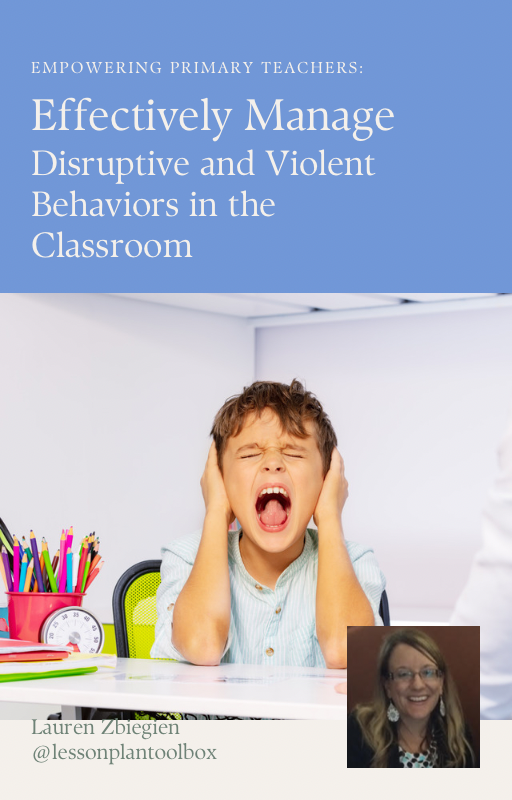
Your ebook GIFT: Empowering Primary Teachers: Effectively Manage Disruptive and Violent Behaviors in the Classroom
FINALLY…
If you enjoyed the tips in this post, you might also enjoy this series of videos Classroom Management by Design for Primary Teachers:
Unlock the Key to Supporting Neurodivergent Learners - Without Overwhelm
Finished Early? Now What? 10 Brilliant Ways to Keep Students Engaged Without the Chaos
A Guide to Creating an Intrinsically Motivated Classroom
Expanding AI's Role in the Primary Classroom
Unlock the Power of AI in the Primary Classroom
Supporting a Student Being Bullied
What to do With a Bully in the Primary Classroom
Don’t forget to follow us over on Instagram!
Teach~Relax~Repeat
Lauren


