
What Most Teachers Don't Know: 5 Ways AI Can Calm Challenging Student Behavior Quickly
Welcome to our yearlong series on Classroom Management by Design for Primary Teachers. Each week we will give you a new piece to the classroom management puzzle to have in place when you need it this school year. Think of it as a Lego kit just waiting to be built.
Classroom Management by Design for Primary Teachers: What Most Teachers Don't Know: 5 Ways AI Can Calm Challenging Student Behavior Quickly
Discover 5 powerful ways AI tools can support K–3 teachers in managing challenging student behavior calmly, quickly, and confidently every day.
It’s 10:47 a.m.
You’re mid-lesson — whiteboard marker in hand — when it happens.
Marcus flips his chair. Again.
You feel the familiar surge of frustration, exhaustion, and that quiet question you’d never say out loud: Am I doing something wrong?
Twenty-two other students are watching. You take a breath. You respond as calmly as you can.
But later, during your four-minute lunch, you wonder: Is there a better way to handle this?
Here’s the thing most teachers don’t hear often enough: you’re already doing the hard work. You’re showing up, staying regulated, and making a hundred micro-decisions every hour. What if a tool could quietly do some of the mental heavy lifting for you?
What Most Teachers Don’t Know About AI and Classroom Behavior
When most teachers hear “AI,” they think chatbots writing essays for students, or some far-off tech that has nothing to do with the reality of a K–3 classroom.
But here’s what’s actually true: AI tools — used thoughtfully — can become one of the most practical supports you have for managing challenging student behavior.
Not because AI understands your students the way you do.
But because AI can help you — a tired, overwhelmed, deeply caring teacher — think more clearly, respond more calmly, and plan more strategically when behavior challenges feel relentless.
The research on teacher stress is clear: when we’re dysregulated, our ability to respond to student behavior thoughtfully drops significantly. AI won’t replace your instincts — it will free up the bandwidth those instincts need to work.
Picture Your Classroom With a Little More Breathing Room
Imagine starting the week with a clear plan for your three most challenging students — not a plan you stayed up until 10 p.m. writing, but one you drafted in fifteen minutes with AI support.
Imagine having a script in your pocket for the exact behavior situations that used to catch you off guard.
Imagine walking into Monday morning feeling prepared instead of bracing for impact.
That’s what’s possible. Here’s how to get there.

5 Ways AI Can Support Your Classroom Management for Primary Students
1. Draft Calm, Consistent Teacher Scripts for Tough Behavior Moments
One of the biggest challenges in K–3 classroom management is knowing what to say in the moment — especially when a student is escalating and your nervous system is, too.
AI tools like ChatGPT or Claude can generate calm, age-appropriate teacher scripts for nearly any behavior scenario you describe.
Try this: Type into an AI tool: “Give me three calm teacher responses I can use when a kindergartener is refusing to transition to a new activity.” Read through the responses, choose the ones that feel like you, and keep them somewhere visible.
Having those words ready in advance means you’re not searching for language while simultaneously keeping 22 other students on task.
2. Build Individualized Behavior Support Plans Faster
Writing a behavior support plan for a student with chronic challenging behavior is time-consuming, often happening after school hours when your brain is running on empty.
AI can help you build a solid first draft in a fraction of the time. You provide the context — the student’s triggers, what escalation looks like, what seems to help — and the AI gives you a structured framework to refine.
Try this: Describe a student’s behavior patterns to an AI tool and ask for a simple, three-part plan that includes prevention strategies, in-the-moment supports, and re-engagement steps. Then adapt it with your professional knowledge of the child.
This isn’t AI replacing your expertise. It’s AI giving you a starting point so you’re not building from scratch at 9 p.m.
3. Generate Regulation Activities Tailored to Your Classroom’s Needs
Not every calming strategy works for every group of students — and what worked with last year’s class might fall completely flat this year.
AI tools can generate a wide variety of regulation activities based on the specific needs, energy level, or time of day you describe.
Try this: Ask an AI tool: “Give me five short movement-based regulation activities for first graders who are dysregulated after lunch recess. Each activity should take under two minutes and require no materials.” You’ll get a list you can pull from anytime.
This is especially helpful when you’re trying to build consistent classroom routines that support student self-regulation before behavior escalates.

4. Prepare Talking Points for Difficult Parent Conversations About Behavior
Parent communication around challenging student behavior is one of the most stressful parts of teaching. You want to be honest, supportive, and solution-focused — all at once, often on short notice.
AI can help you think through what to say before you pick up the phone or sit down for a conference.
Try this: Give the AI a brief description of the situation and ask it to draft three key talking points that lead with empathy, describe the behavior specifically, and offer a collaborative next step. Then practice saying them in your own words.
Walking into a hard conversation with a clear framework reduces teacher stress and often leads to better outcomes for the student.
5. Reflect on Behavior Patterns to Uncover What’s Really Going On
Sometimes the most powerful thing you can do for a student with chronic behavior challenges is slow down and look for patterns — but that kind of reflection takes time and mental space that most K–3 teachers don’t have built into their day.
AI can serve as a thinking partner. By describing what you’re observing — when behaviors happen, what precedes them, what follows — you can use AI to help you identify possible functions of behavior or environmental triggers you might be missing.
Try this: Tell the AI: “A second grader in my class often becomes disruptive during independent writing time. He’s fine during read-alouds and math games. What might be driving this behavior and what should I consider trying?” Use the AI’s response as a jumping-off point for your own professional observations.
This kind of reflective analysis is exactly what behavior specialists do — and now you can access a version of it without waiting for a meeting.

Why This Works: The Brain Science Behind It
Here’s something worth knowing: teacher stress directly impacts student behavior.
When you’re in a state of chronic stress, your prefrontal cortex — the part of the brain responsible for calm decision-making, emotional regulation, and creative problem-solving — has less capacity. Your responses become more reactive, less reflective.
Using AI tools to reduce the cognitive load of behavior planning gives your brain back the bandwidth it needs to be the regulated, responsive adult your students need in the room.
It’s not about working smarter as a cliché. It’s about protecting your nervous system so you can protect theirs.

A Note Just for You
Managing challenging student behavior in a K–3 classroom is some of the most nuanced, demanding work any professional does — anywhere.
You’re not just teaching phonics and number sense. You’re teaching tiny humans how to exist in a group, manage their emotions, and try again after they’ve failed. That is enormous work.
Using every tool available to you — including AI — isn’t cutting corners. It’s being resourceful in service of your students and yourself.
You deserve support too.
Want a Head Start?
If you want to start building your behavior response toolkit without spending hours thinking from scratch, my Student Behavior Scenario Cards are a powerful starting point. They walk teachers through real classroom behavior situations with guided reflection questions — the exact kind of thinking that helps you figure out what a student needs before behavior escalates.
You can also explore the Lesson Plan Toolbox for done-for-you strategies that reduce teacher stress and build the kind of predictable, calm classroom routines that make student regulation — and your regulation — possible.
One Small Step for Tomorrow Morning
Before tomorrow’s school day, open an AI tool and type this:
“Give me three calm teacher responses I can use when a primary student is starting to escalate during a transition.”
Read through them. Pick one that sounds like you. Write it on a sticky note.
Sometimes the smallest shift in preparation creates the biggest shift in your classroom.
DID YOU KNOW…
Did you know I organize a FREE Facebook Group for Mastering Classroom Management? We are gearing up for our school year quarter sessions, so if you’re looking for a simple way to improve your classroom management join the already 200+ teachers that have signed up: Mastering Classroom Management Facebook Group
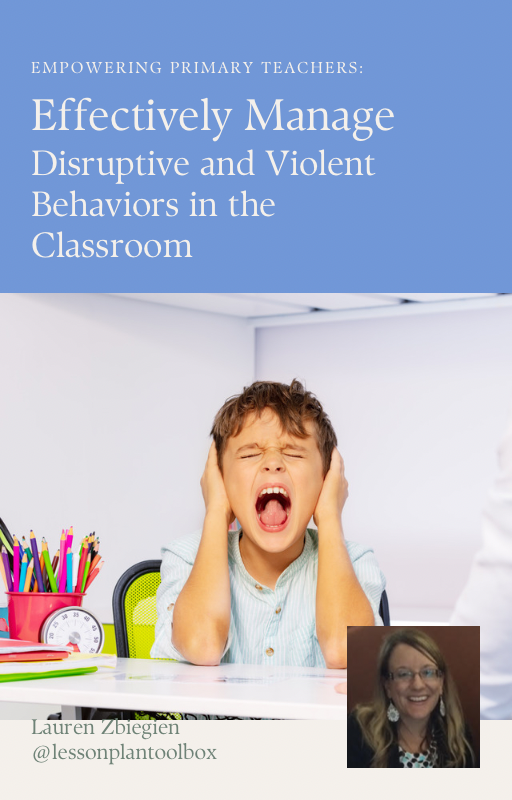
Your ebook GIFT: Empowering Primary Teachers: Effectively Manage Disruptive and Violent Behaviors in the Classroom
FINALLY…
If you enjoyed the tips in this post, you might also enjoy this series of Classroom Management by Design for Primary Teachers:
The Hidden Reason Some Students Can't Focus Before Lunch
Teaching Accountability to Young Students: A Practical Guide for K–3 Teachers
Unlock the Key to Supporting Neurodivergent Learners - Without Overwhelm
Finished Early? Now What? 10 Brilliant Ways to Keep Students Engaged Without the Chaos
A Guide to Creating an Intrinsically Motivated Classroom
Expanding AI's Role in the Primary Classroom
Unlock the Power of AI in the Primary Classroom
Supporting a Student Being Bullied
Don’t forget to follow us over on Instagram!
Teach~Relax~Repeat
Lauren
✨ Want ready-to-use tools that back this up?
The Lesson Plan Toolbox is built for K–3 teachers who want brain-based systems,
not just printables. Behavior tools, regulation frameworks, parent communication scripts,
and a community of teachers who actually get it.


