
How to Stay Calm, Safe, and Firm with an Explosive Kindergarten Student
Welcome to our yearlong series on Classroom Management by Design for Primary Teachers. Each week we will give you a new piece to the classroom management puzzle to have in place when you need it this school year. Think of it as a Lego kit just waiting to be built.
Classroom Management by Design for Primary Teachers: How to Stay Calm, Safe, and Firm with an Explosive Kindergarten Student
Classroom management in kindergarten is probably one of the most overlooked areas in education. Here is one teacher’s story that she wanted to share with others who may be having the same experience:
The chair left his hands before I could react.
Twenty little faces froze, my heart pounded, and in the split second between ducking and deciding what to do next, one thought ran through my mind: “I cannot lose this battle with a 5-year-old.”
So I did what so many of us have been trained—implicitly or explicitly—to do.
My voice became firm. I tightened my rules. I stated consequences. I got pulled into a power struggle with a kindergartener.
The student would then run out of the room.
What followed were more episodes of screaming, more hitting, and more time with me physically and emotionally bracing for the next explosion. Meanwhile, the principal would cave to almost anything to keep him happy, and his mom assured us, “He doesn’t behave like this at home.” I felt alone, unsafe, and blamed—while still trying to teach the alphabet.
If you’ve ever been in that impossible intersection of dangerous behavior, mixed messages from leadership, and “He’s fine at home,” this is for you.
What’s Really Happening (It’s Not “Just a Bad Kid”)
When a young child is throwing chairs, hitting adults, or screaming over small corrections, it is easy to label them as “out of control,” “manipulative,” or “bad.”
But underneath the behavior is a nervous system that is firing like an alarm.
At school, this child may be overwhelmed by:
Constant directions and corrections
Noise, movement, and expectations that feel huge
Separation from their caregiver and the pressure to perform socially and academically
The behavior we see—throwing, hitting, screaming—is the outside expression of an inside system that feels threatened.
That doesn’t mean we accept it, excuse it, or allow unsafe actions. It does mean that a “win-lose” mindset (me vs. the child) often turns up the heat rather than turning it down.
One thing that helped me reframe this was intentionally studying behavior outside the crisis. Using short, structured discussions—like walking through a student behavior scenario during a calm moment—helped me see patterns and triggers without the emotional charge of the moment itself.

How I Got Stuck in a Power Struggle (And How You Might Be, Too)
When the behavior escalated, my instincts kicked in. I told myself:
“If I let him win, he’ll never listen again.”
“He has to learn I’m in charge.”
“I can’t let the class think this behavior works.”
So I:
Matched his volume with my own
Threatened to take away favorite activities
Insisted on compliance in the heat of the moment
Tried to “reason” with a child whose brain was already in full fight-or-flight
The more I pushed, the more he exploded.
A power struggle in kindergarten often looks like:
“If you throw that chair again, you’re losing recess all week!”
“You need to look at me right now and say you’re sorry.”
“You’re not leaving this spot until you can tell me why you did that.”
The underlying message becomes: “I must win. You must lose.”
For a child who already feels unsafe or out of control, that “you must lose” can feel like another threat, and their behavior intensifies.
What finally shifted things for me was giving up the idea of “winning” and instead taking on a different role: the calm, predictable, safety-focused adult.

In the Moment: Safety First, Not Victory
When a child is throwing chairs or hitting, your first job is not to convince them, correct them, or teach a lesson.
Your first job is safety.
In my classroom, that now looks like:
Move everyone to safety.
A simple, practiced routine: “Friends, line up at the door,” or “Table groups, go to your safe spots.”
I focus on calmly directing the other children, not on lecturing the child who is escalated.
Use a neutral, brief script with the student.
“I won’t let you hurt me or anyone else.”
“I’m moving everyone to be safe.”
“You can sit by the shelf or the rug while your body calms.”
Short, steady phrases send a far more powerful message than yelling ever did.
Drop the lecture until later.
No explaining the rule in that moment.
No asking why they did it.
No demanding an apology while their nervous system is still on fire.
Offer simple, regulated choices.
“Do you want to sit on the rug or in the chair by my desk while you calm down?”
“Do you want to hold the pillow or squeeze the ball?”
The focus in the crisis is not “fixing the behavior” but containing it and keeping everyone safe.

After the Storm: De-escalation and Repair
(How to Handle Challenging Behavior in K–3)
Once the child’s body is calmer (breathing slower, no longer trying to hit or throw), that’s the moment for connection and teaching.
Here is a simple three-step flow that has helped:
1. Name the feeling and hold the boundary.
“You were really mad when I corrected you.”
“It’s okay to be mad. It’s not okay to throw chairs or hit.”
2. Give the feeling a safe pathway.
“When you feel that mad next time, you can stomp on the X on the floor or squeeze the pillow.”
“You can say, ‘I’m mad,’ and go to the calm spot, but you still need to keep your body safe.”
This is also where tools like short behavior scenarios become powerful. Talking through a “what would you do next time?” situation—without blame—helps young children rehearse safer choices before the next hard moment hits.
3. Practice the “next time” right away.
Role-play: “I’m going to pretend to correct you. Show me your safe angry plan.”
Celebrate even a small success: “You didn’t throw. You chose to stomp. That’s your brain getting stronger.”
Repair also includes the rest of the class:
Briefly acknowledge what happened in age-appropriate language: “This morning was scary. Our job is to keep everyone safe, and we’re practicing how to handle big feelings.”
Reassure them that adults are working on a plan and that it is not their job to fix it.

Between Incidents: Teaching Skills, Not Just Giving Consequences
(How to Use Consequences that Actually Work)
No amount of consequence alone will teach a young child how to handle correction and frustration differently.
We have to teach the missing skills.
A few proactive moves:
Track patterns.
For a week or two, jot down:
Time of day
Activity (whole group, centers, transitions, work they find hard)
What happened right before the explosion
How tired, hungry, or overstimulated they seemed
Patterns often reveal “hotspots” you can adjust.
Pre-teach how to handle correction.
Create a short script: “When the teacher reminds you, your job is: stop, breathe, try again.”
Practice it when the child is calm, using puppets, visuals, role-play, or even daily behavior scenario discussions that normalize mistakes and corrections.
Create a “safe angry plan.”
Tape a stomp spot on the floor
Provide a pillow, stress ball, or scrap-paper tearing basket
Use visuals that show: I feel mad → I choose a safe action → My body feels safer
Reinforce like crazy.
Any time they accept a correction without hitting or throwing, name it specifically:
“You got mad, but you kept your body safe. That is a big deal.”

When Admin Caves: Mixed Messages and Moving Forward
(How Can I Just Stop Reacting to Behavior)
One of the hardest parts of my situation was feeling like the message from the office was, “Just keep him happy, no matter what.”
If the pattern becomes: child escalates → admin caves → child gets what they want, then the behavior is not just unmanaged; it’s reinforced.
As a classroom teacher, you often can’t control what a principal does, but you can:
Name the pattern respectfully
Request a written safety plan
Frame everything around shared goals
You are not being “difficult” when you ask for clarity.
You are doing your job.

“He Doesn’t Do This at Home”: Working With Caregivers
Hearing “He doesn’t act like this at home” can land like a punch in the gut.
But home and school are radically different environments.
Rather than arguing, stay curious and collaborative:
Ask how corrections are handled at home
Explore routines that may impact regulation
Align language around safety and limits
Sometimes sharing specific classroom scenarios—rather than abstract descriptions—helps caregivers understand what their child is navigating and how you’re responding.

Protecting Your Own Nervous System and Boundaries
Through all of this, your nervous system is also on high alert.
A few practices that helped me:
A grounding phrase: “My job is safety and calm, not winning.”
Micro-regulation during incidents
Debriefing with someone who validates, not blames
You deserve safety.
You can care deeply and still ask for support and clear protocols.

Questions to Reflect On (And an Invitation)
Where am I getting pulled into power struggles?
What does my body need in those moments?
What patterns am I noticing?
What support do I need from leadership?
You are not alone.
There are thousands of teachers quietly dodging chairs and navigating mixed messages every day, wondering if they’re doing something wrong.
If you’re willing, share your experience.
Your story might be exactly what another teacher needs to hear.
We would love to hear from and show other teachers that it is not you—it is nervous systems and self-regulation.
([email protected])
Manage Student Behavior in 5 Minutes a Day!
Do you see student behavior going through the roof right about now?
Have you tried EVERYTHING and NOTHING seems to work?
Trust me, I've been there!
This is EXACTLY why I created The Student Behavior Scenario of the Day Cards for primary teachers. You will improve student behavior AND your classroom management in just 5 minutes a day!
As teachers, we can't assume that students know how to behave or what is expected of them and so often that is where things go wrong for us. (We all know what happens when we ''assume", but yet we still do it anyway.)
These cards changed EVERYTHING for me in the primary classroom because students LOVE talking about behavior AND they want to meet your expectations.
Best of all, each card has scenario of the day, reflection questions, and possible consequences that teachers can use in each situation.
GRAB YOUR FREE SAMPLE HERE: Student Behavior Scenario of the Day Cards
DID YOU KNOW…
Did you know I organize a FREE Facebook Group for Mastering Classroom Management? We are gearing up for our school year quarter sessions, so if you’re looking for a simple way to improve your classroom management join the already 200+ teachers that have signed up: Mastering Classroom Management Facebook Group
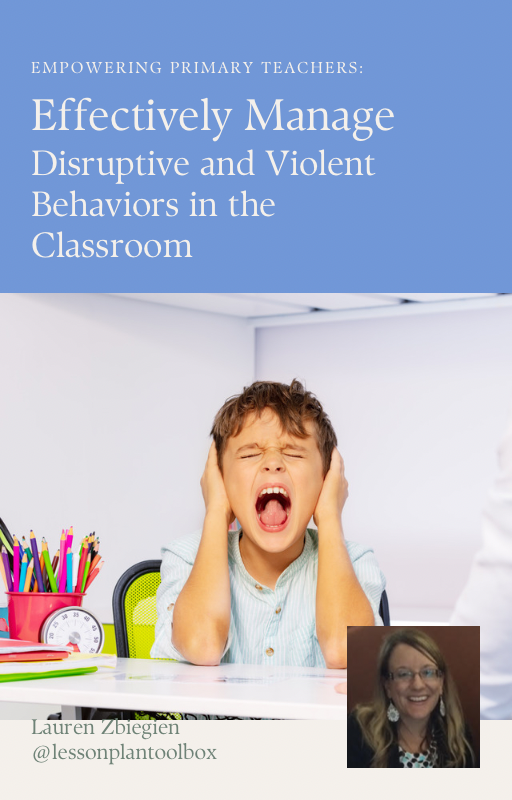
Your ebook GIFT: Empowering Primary Teachers: Effectively Manage Disruptive and Violent Behaviors in the Classroom
FINALLY…
If you enjoyed the tips in this post, you might also enjoy this series of videos Classroom Management by Design for Primary Teachers:
Unlock the Key to Supporting Neurodivergent Learners - Without Overwhelm
Finished Early? Now What? 10 Brilliant Ways to Keep Students Engaged Without the Chaos
A Guide to Creating an Intrinsically Motivated Classroom
Expanding AI's Role in the Primary Classroom
Unlock the Power of AI in the Primary Classroom
Supporting a Student Being Bullied
What to do With a Bully in the Primary Classroom
Don’t forget to follow us over on Instagram!
Teach~Relax~Repeat
Lauren


