
Decision Fatigue, Compassion Fatigue, and Why Classroom Management Feels so Hard Right Now
Welcome to our yearlong series on Classroom Management by Design for Primary Teachers. Each week we will give you a new piece to the classroom management puzzle to have in place when you need it this school year. Think of it as a Lego kit just waiting to be built.
Classroom Management by Design for Primary Teachers: Decision Fatigue, Compassion Fatigue, and Why Classroom Management Feels So Hard Right Now
By the time the morning announcements end, most primary teachers have already made more decisions than many adults will make all day.
Not big decisions.
Tiny ones.
Relentless ones.
Who needs help first.
Whether that behavior needs redirection or grace.
How firm your voice should be.
Whether this moment is defiance, dysregulation, or exhaustion.
Whether to stop the lesson or keep going.
Research estimates that teachers make around 1,500 decisions during a single school day (Teachers in Their Power). Primary teachers often exceed that number because young children require constant supervision, emotional co-regulation, and immediate safety judgments.
That level of cognitive demand changes the brain by mid-afternoon.
And when it goes unnamed, it quietly reshapes classroom management in ways teachers often blame on themselves.

What Is Decision Fatigue?
Decision fatigue occurs when the brain becomes depleted from making too many decisions over time, reducing the quality, clarity, and consistency of later choices.
It is not laziness.
It is not disorganization.
It is not “losing your edge.”
It is neuroscience.
Every decision, even a small one, draws from the same limited pool of mental energy. In primary classrooms, decisions stack rapidly:
Do I address this now or later?
Do I redirect quietly or publicly?
Is this a behavior issue or a regulation issue?
Do I send the note home or wait?
Do I enforce the consequence or offer flexibility?
By lunchtime, many teachers notice a shift.
By dismissal, it can feel like survival mode.
Decision fatigue often shows up as:
Shortened patience
Inconsistent follow-through
Increased reactivity
Avoidance of “one more thing”
Feeling overwhelmed by small choices
Not because teachers do not care.
But because the brain is conserving energy.

What Is Compassion Fatigue?
While decision fatigue drains the mind, compassion fatigue drains the heart.
Compassion fatigue is the emotional exhaustion that comes from prolonged exposure to others’ needs, distress, trauma, and dysregulation, especially when recovery time and support are limited.
Primary teachers are not just instructors.
They are:
Emotional anchors
Safety figures
First responders to big feelings
Co-regulators for developing nervous systems
They absorb stories.
They absorb stress.
They absorb energy.
Compassion fatigue can look like:
Feeling emotionally numb
Irritability or guilt
Dreading certain parts of the day
Pulling back emotionally from students
Questioning your effectiveness as a teacher
And because teaching is framed as a “calling,” many educators feel shame even naming this fatigue.
But compassion fatigue does not come from a lack of love.
It comes from sustained care without adequate restoration.

Where These Two Collide in the Primary Classroom
Decision fatigue and compassion fatigue rarely operate alone.
They collide.
When the brain is tired and the heart is heavy, classroom management becomes harder to sustain, even with strong systems in place (Am I Even Making a Difference).
Teachers may notice:
Power struggles increasing
Tone becoming sharper than intended
Inconsistency with consequences
Abandoning strategies that once worked
Feeling “on edge” all day
This is not a classroom management failure.
It is a nervous system under pressure.
When teachers are depleted, the brain prioritizes immediacy over intention. Responses become faster, louder, or more rigid because flexibility requires energy.

How Fatigue Impacts Behavior Management
Classroom management is often discussed as if it exists separately from the teacher’s internal state.
It does not.
When decision fatigue sets in:
Consistency feels harder, not because expectations changed, but because follow-through costs more energy.
Calm responses require effort instead of flowing naturally.
Proactive strategies get skipped in favor of quick fixes.
When compassion fatigue is present:
Teachers may emotionally withdraw to protect themselves.
Empathy can feel forced.
Patience becomes a resource to ration.
The result?
Teachers feel like they are either:
Too strict
Too permissive
Or constantly putting out fires
None of which reflect their actual skill or values.

Why Primary Teachers Are Especially Vulnerable
Primary classrooms require:
Continuous supervision
Physical proximity
High sensory input
Immediate safety decisions
Emotional co-regulation throughout the day
Young children are still learning how to regulate their bodies, emotions, and impulses. Teachers often lend their nervous systems again and again.
This is exhausting work, even in well-supported environments.
In under-resourced settings, it can feel unsustainable.

This Is Not a Call to “Do More”
When teachers struggle with classroom management under fatigue, the advice is often:
Add another system
Be more consistent
Tighten expectations
Try a new strategy
But primary teachers do not need more.
They need:
Fewer decisions
Simpler systems
Predictable responses
Structures that protect energy
Effective classroom management in today’s primary classrooms is less about control and more about capacity (5 Creative Ways to Calm a Chaotic Classroom).

What Actually Supports Teachers and Classrooms
Predictable routines reduce cognitive load.
When responses are practiced and visualized, the brain rests.
Fewer strategies used consistently.
Depth creates ease. Familiarity creates calm.
Movement and regulation built into the day.
Not as rewards. Not as extras. As foundational supports.
Behavior systems that do not rely on emotional depletion.
Calm, repeatable responses that work even on tired days.
Permission to name fatigue without judgment.
Awareness alone reduces shame and restores clarity.

A Needed Reframe
If classroom management feels harder than it used to, it does not mean you are failing.
It means:
You are making thousands of decisions a day.
You are carrying emotional weight most people never see.
You are working inside a system that asks for more without giving enough back.
Decision fatigue and compassion fatigue are not weaknesses.
They are signals.
Signals that classrooms must be designed to support the teacher’s nervous system, not just student behavior (How Can I Stop Just Reacting to Behavior).

Where This Leaves Us
Primary teachers are not burnt out because they lack passion.
They are fatigued because they are human.
The solution is not to push harder.
It is to build classrooms, routines, and behavior systems that protect energy instead of draining it.
Calm classrooms are not created through louder voices or stricter rules.
They are built through regulation, rhythm, and realistic expectations (The Hidden Power of Silence: An Essential Skill for Classroom Behavior Management).
And teachers deserve environments that care for them as much as they care for their students.
If planning time does not restore you, you are not broken.
You are responding to sustained demand without sufficient recovery.
Naming that truth is not giving up.
It is the first step back to calm, confidence, and clarity in the classroom.
Manage Student Behavior in 5 Minutes a Day!
Do you see student behavior going through the roof right about now?
Have you tried EVERYTHING and NOTHING seems to work?
Trust me, I've been there!
This is EXACTLY why I created The Student Behavior Scenario of the Day Cards for primary teachers. You will improve student behavior AND your classroom management in just 5 minutes a day!
As teachers, we can't assume that students know how to behave or what is expected of them and so often that is where things go wrong for us. (We all know what happens when we ''assume", but yet we still do it anyway.)
These cards changed EVERYTHING for me in the primary classroom because students LOVE talking about behavior AND they want to meet your expectations.
Best of all, each card has scenario of the day, reflection questions, and possible consequences that teachers can use in each situation.
GRAB YOUR FREE SAMPLE HERE: Student Behavior Scenario of the Day Cards
DID YOU KNOW…
Did you know I organize a FREE Facebook Group for Mastering Classroom Management? We are gearing up for our school year quarter sessions, so if you’re looking for a simple way to improve your classroom management join the already 200+ teachers that have signed up: Mastering Classroom Management Facebook Group
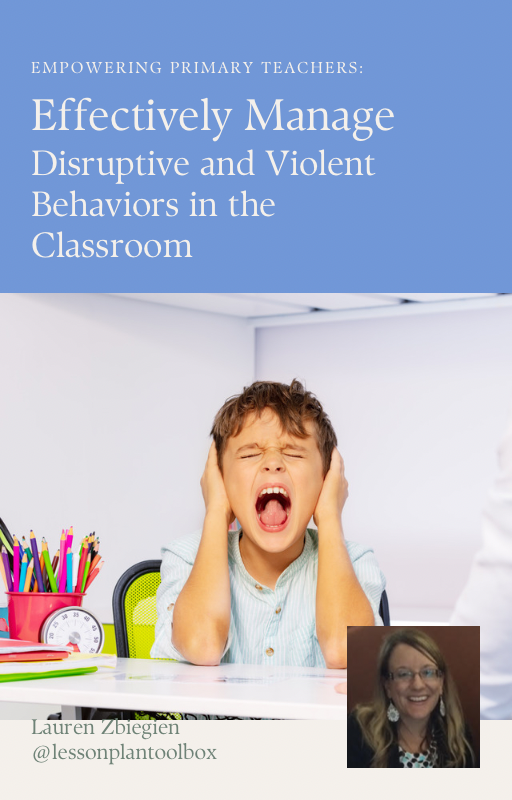
Your ebook GIFT: Empowering Primary Teachers: Effectively Manage Disruptive and Violent Behaviors in the Classroom
FINALLY…
If you enjoyed the tips in this post, you might also enjoy this series of videos Classroom Management by Design for Primary Teachers:
Unlock the Key to Supporting Neurodivergent Learners - Without Overwhelm
Finished Early? Now What? 10 Brilliant Ways to Keep Students Engaged Without the Chaos
A Guide to Creating an Intrinsically Motivated Classroom
Expanding AI's Role in the Primary Classroom
Unlock the Power of AI in the Primary Classroom
Supporting a Student Being Bullied
What to do With a Bully in the Primary Classroom
Don’t forget to follow us over on Instagram!
Teach~Relax~Repeat
Lauren


